Phone : +91 98251 83643
Email : info@swatiwater.com
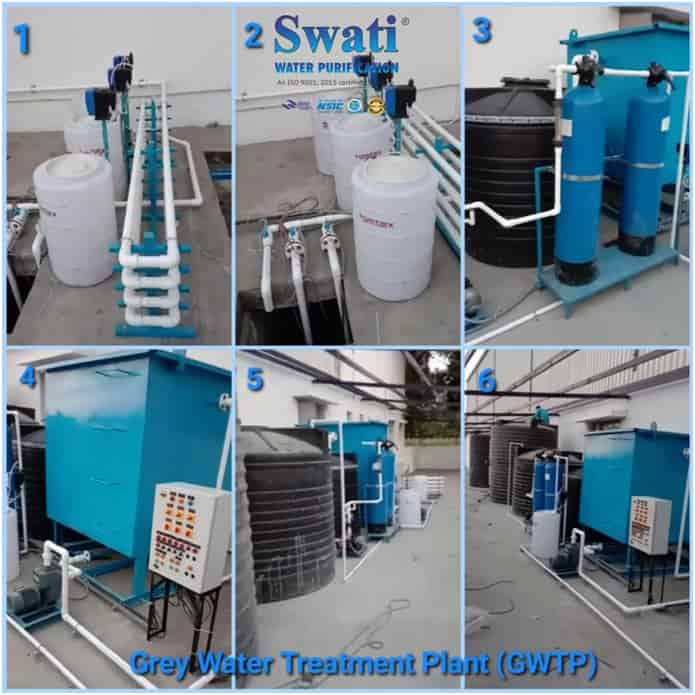
Swati Water Purification is a trusted Grey Water Treatment Plant Manufacturer, delivering advanced and cost-effective solutions for sustainable water reuse. Our Grey Water Treatment Plant is designed to treat wastewater from bathrooms, wash basins, laundry, and kitchens, converting it into reusable water for flushing, gardening, cooling towers, and various non-potable applications.
Our systems use modern filtration, biological treatment, and disinfection technologies to ensure high purification efficiency with minimal maintenance. Each Grey Water Treatment Plant is engineered for long service life, easy installation, and energy-efficient performance, making it ideal for residential societies, hotels, commercial complexes, institutions, and industrial facilities. As a leading Grey Water Treatment Plant Manufacturer, Swati Water Purification focuses on delivering customized solutions that meet environmental standards while helping clients reduce freshwater consumption and operational costs. Our plants ensure maximum water recovery, eco-friendly operation, and consistent output quality.
Grey Water Treatment Plants are available in a wide range of capacities to meet the water recycling needs of residential, commercial, and industrial sectors. These systems can be designed in the following capacity ranges:
5 KLD to 50 KLD, with some larger systems reaching up to 100 KLD (Common capacities: 10 KLD, 15 KLD, 20 KLD, 25 KLD, 30 KLD, 50 KLD, 75 KLD, 80 KLD, 100 KLD)
1,000 LPH to 50,000 LPH, and advanced large-scale plants reaching up to 100,000 LPH for high-volume water recycling.
These capacities make GWTPs suitable for efficiently treating wastewater from bathrooms, laundry, kitchens, and other non-sewage sources.
Grey Water Treatment Plants help recycle and reuse wastewater for non-potable needs, significantly reducing dependency on fresh water and lowering operating costs in various industries.
Commercial Buildings: Used in office complexes, malls, and corporate buildings to recycle grey water for toilet flushing, landscaping, and cleaning, reducing water bills and environmental impact.
Manufacturing Industries: Treats water from industrial washing, cooling, or cleaning processes and reuses it for non-potable applications, helping industries save water and reduce wastewater discharge.
Power Plants: Treated grey water is used for cooling towers, non-critical cleaning, and landscaping, minimizing the consumption of freshwater in power generation facilities.
Hotels & Resorts: Treats grey water from bathrooms, sinks, and laundry, which is then reused for gardening, toilet flushing, and general cleaning—making the facility more sustainable.
Food & Beverage Industry: Grey water from washing and cleaning processes can be treated and reused for floor washing, cooling systems, and landscaping to reduce water wastage.
Construction Sites: Treated grey water is useful for dust suppression, equipment cleaning, and site landscaping, reducing reliance on fresh water resources.
Textile Industry: Water from washing and rinsing fabrics is treated and reused in non-production processes such as cooling, cleaning, and floor washing, helping conserve water.
A Grey Water Treatment Plant is a system designed to treat and recycle grey water — wastewater generated from showers, sinks, laundry, and other non-toilet sources. It removes contaminants so the water can be reused for non-potable purposes, reducing freshwater consumption.
Reduces freshwater usage
Lowers water bills
Supports sustainable water management
Enables reuse of treated water for flushing, gardening, cooling, etc.
Overall, it helps conserve water and protect the environment.
A typical GWTP includes several stages:
Pre-treatment: Removes debris and large solids.
Primary treatment: Settles out bigger particles.
Secondary (biological) treatment: Reduces organic matter biologically.
Tertiary treatment: Advanced filtration and disinfection to polish the water.
Storage & distribution: Clean water is stored for reuse.
Treated grey water can be reused for:
Toilet flushing
Landscaping or gardening
Cooling towers
Cleaning or washing non-food surfaces
This reuse helps cut fresh water demand.
Yes — treated grey water can be used for irrigation, garden watering, and landscaping, provided the system includes appropriate filtration and disinfection to remove contaminants.